Not every tree cools a city the same way.

A global meta-analysis of 182 studies across 110 cities reveals why urban tree cooling ranges from dramatic to negligible — and how to plant for the climate you're in.

Record summers are now the norm.

Human-driven climate change has made heatwaves longer, hotter, and more frequent, intensifying the urban heat island that makes cities warmer than the land around them. In response, planners reach for the obvious remedy: plant more trees. New York, Paris, and Shanghai have each launched One Million Tree campaigns.

Trees are widely treated as the ultimate panacea for urban heat — but the evidence says it's not that simple.
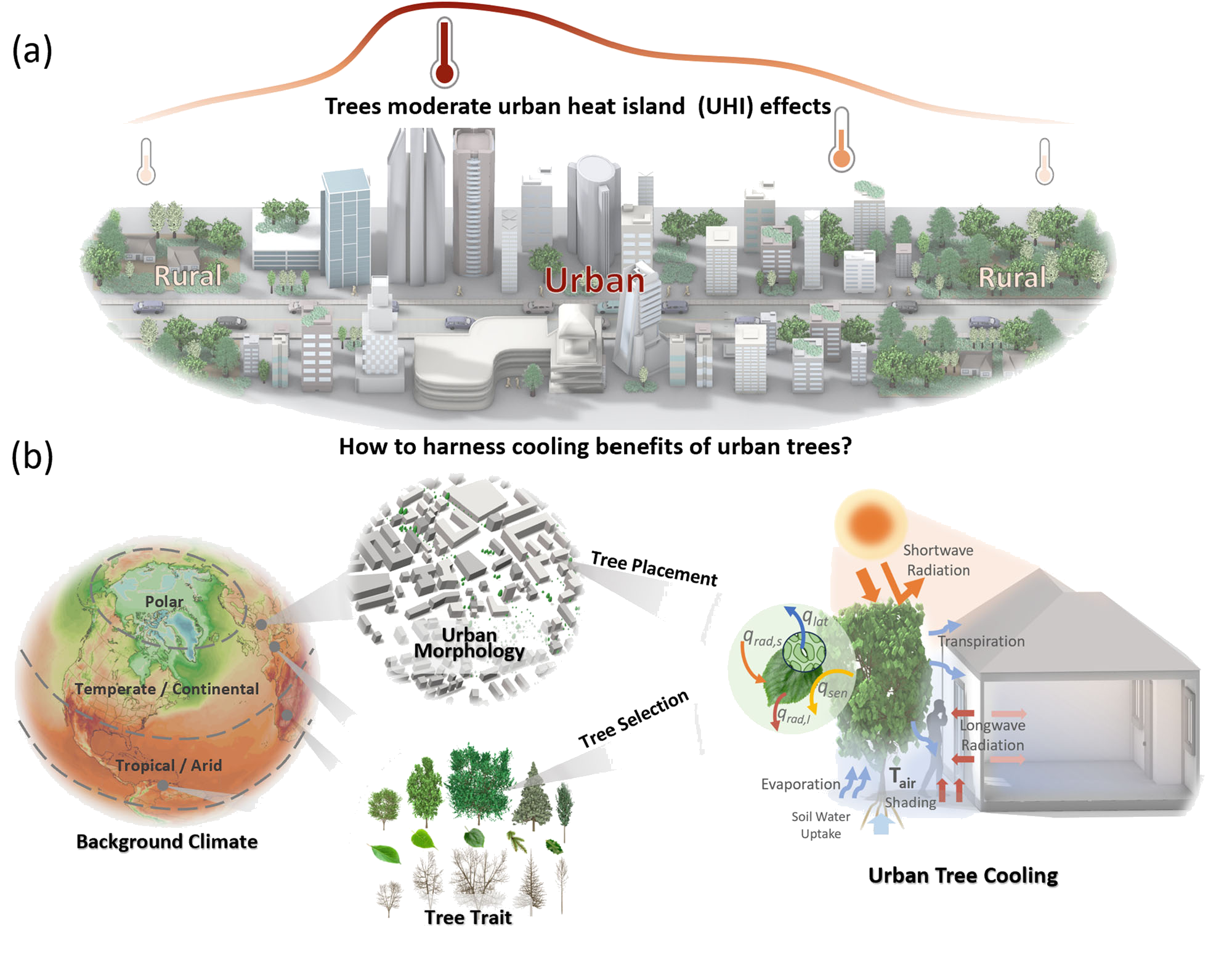
Schematic of urban trees moderating urban heat island warming.
Their cooling efficacy varies globally and is influenced by three primary factors: tree traits, urban morphology, and climate conditions.

Li et al., Communications Earth & Environment (2024)

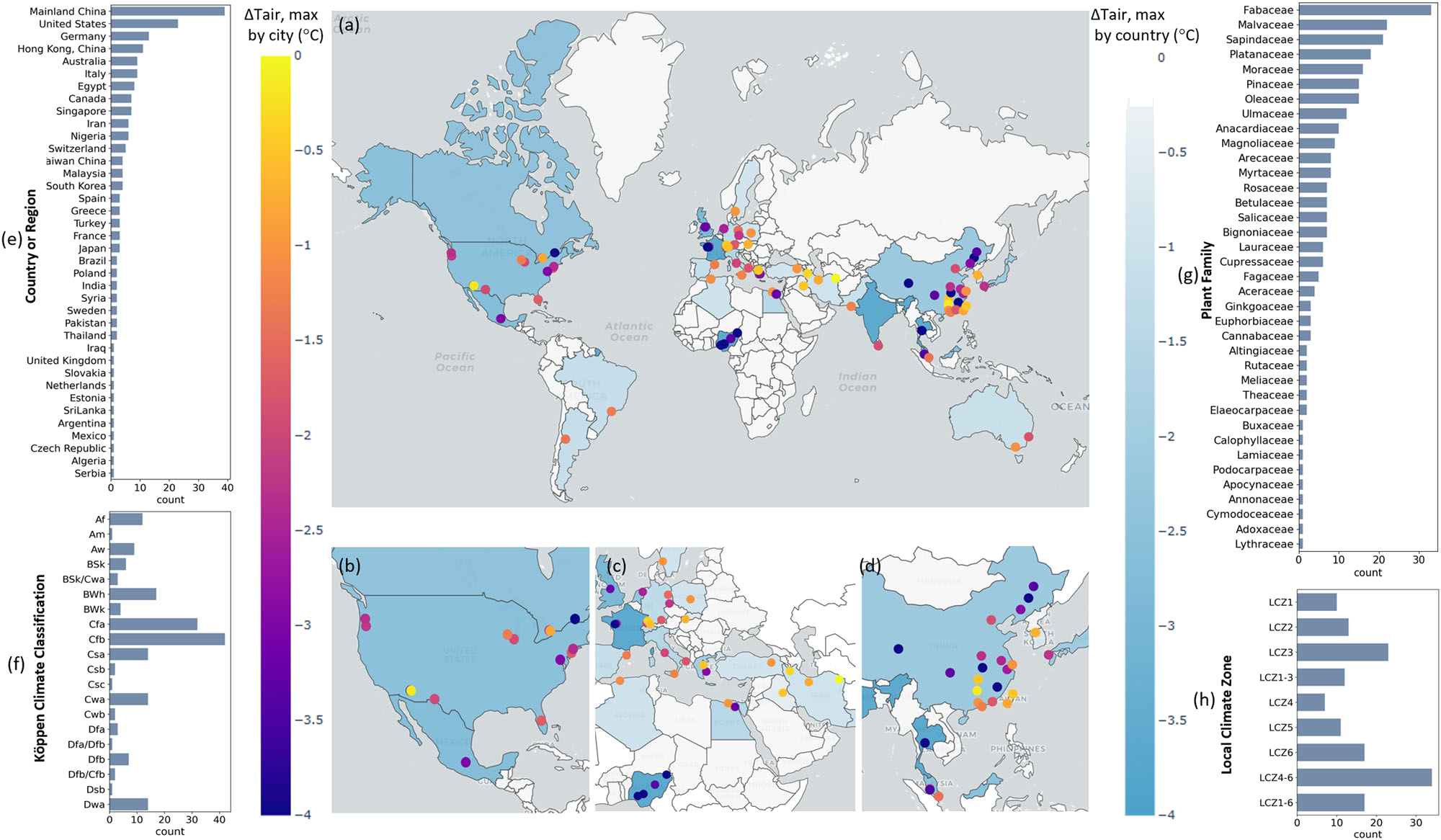
World map of the geographic distribution of urban tree heat mitigation studies.

One global evidence base

Following PRISMA guidelines, the authors meta-analyzed 182 peer-reviewed studies published since 2010, spanning 17 climate zones across 110 cities and regions in 32 countries. Most measure pedestrian-level air temperature — the metric appearing in over 70% of studies — at the micro and local scales where people actually feel heat.

What trees can do

Across the analyzed cities, well-placed trees push peak heat down hard — but the ceiling and the failure cases both matter.

12 °C Maximum pedestrian-level cooling, via radiation blockage and transpiration
83% Of cities brought below a 26 °C peak monthly temperature with trees
5.7 °C Highest cooling potential, reached in continental climates
−8 to +4 °C Range of thermal-comfort (PET) change — trees can also warm at night

Climate sets the ceiling

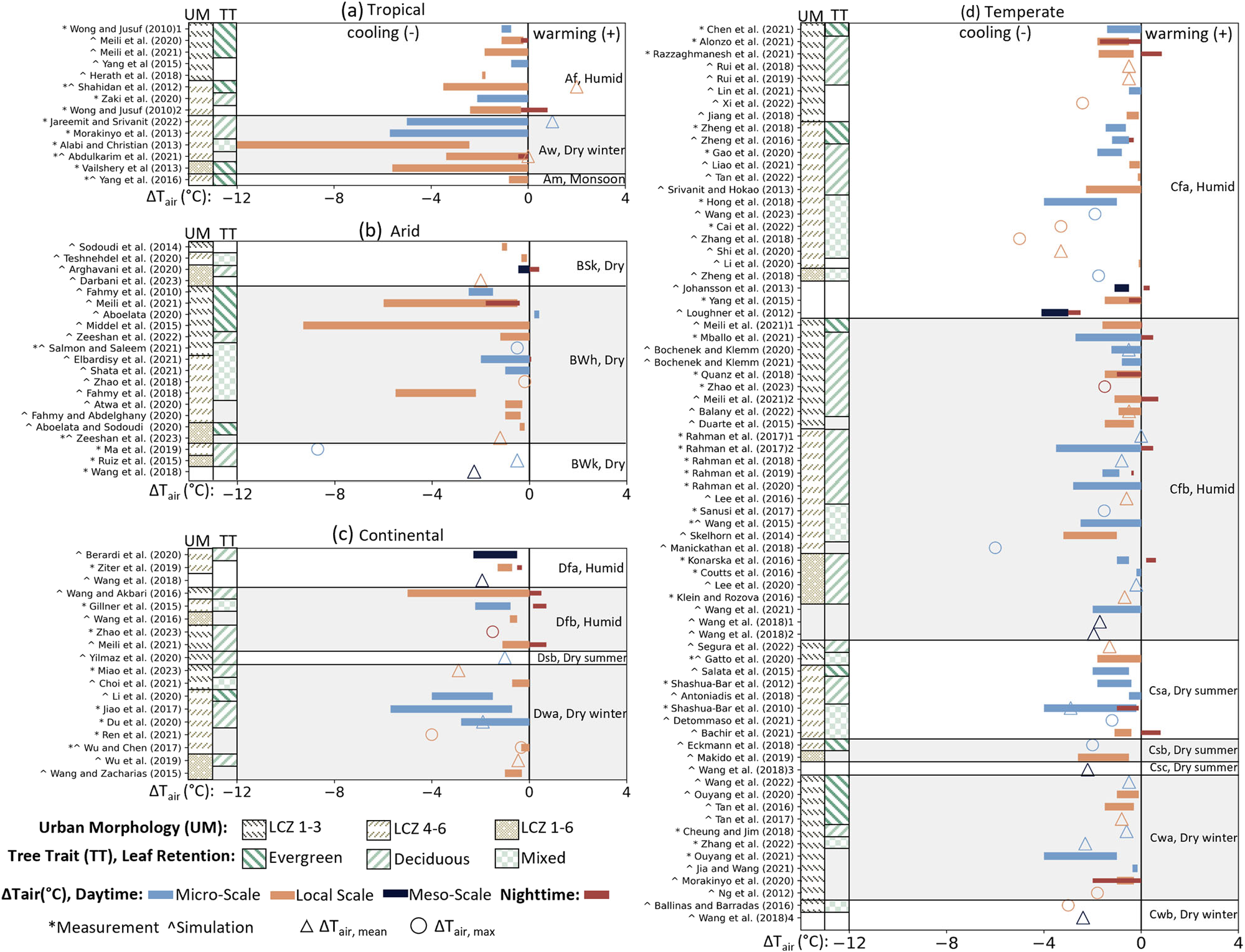
Cooling efficacy swings with background climate and time of day. In humid tropical cities, the maximum daytime cooling can exceed dry-tropical cities by 2.12 °C, while in temperate zones that humid-versus-dry gap nearly vanishes. Nighttime is where trees can backfire — dense canopies trapping longwave radiation occasionally warm humid continental streets after dark.

Tree traits, urban morphology, and background climate are highly interconnected — none can be optimized in isolation.
Diurnal variation of tree cooling efficacy across tropical, arid, continental, and temperate climates.

Open streets cool more

Averaged across studies, open low-rise urban form (LCZ 4–6) lets trees deliver markedly more mean air-temperature cooling than compact built-up form (LCZ 1–3) — because a more visible sky gives canopies room to shade and ventilate. The effect is strongest in the tropics.

Plotted from the paper’s data table.

Right tree, right place

There is no universal greening recipe. In tropical, temperate, and continental climates, mixing deciduous and evergreen trees in open urban form gives about 0.5 °C more cooling than a single-species approach. In arid climates, evergreens packed into compact form work best. Matching species and placement to local climate and built form — not just planting more — is what converts trees into reliable cooling.

Use context-specific greening guidelines to harness tree cooling in the face of global warming.

Credits